
Sector notes
The Scope 3 number your customer needs is sitting in your OT data
From the 2026 financial year, Singapore's largest listed companies must disclose Scope 3 emissions, and a supplier with no activity-based data to offer becomes the industry-average estimate their customer is stuck reporting.

Executive summary
FY2026
the year STI-listed companies must start disclosing Scope 3 emissions
4
calculation methods in the GHG Protocol's accuracy hierarchy; spend-based is the least accurate
Core conclusions
- A supplier that provides no activity-based data becomes the industry-average estimate its customer is stuck reporting.
- Moving up the GHG Protocol's accuracy hierarchy requires the plant floor's existing energy and fuel data logged at a granularity that can be allocated to one order. No new disclosure programme.
- A verifier asks where the figure came from: the meter, the log, the date. A spend-based estimate cannot answer that by construction.
From the financial year starting 1 January 2026, Straits Times Index constituents on SGX must disclose Scope 3 emissions, on top of the Scope 1 and 2 reporting already mandatory for all listed companies from FY2025. For most of them, a material share of that Scope 3 number is Category 1: the emissions embedded in what they buy: raw materials, contract manufacturing, freight.
That number has to come from somewhere, and the GHG Protocol is explicit about where it comes from when a supplier does not provide it: a spend-based estimate, built from an industry-average emission factor applied to the invoice value. That is the least accurate tier the Protocol defines, and it behaves oddly in ways a verifier will ask about. Negotiate a discount with a vendor and the reported emissions fall, with nothing about the physical activity having changed.
The Protocol's own hierarchy, least to most accurate
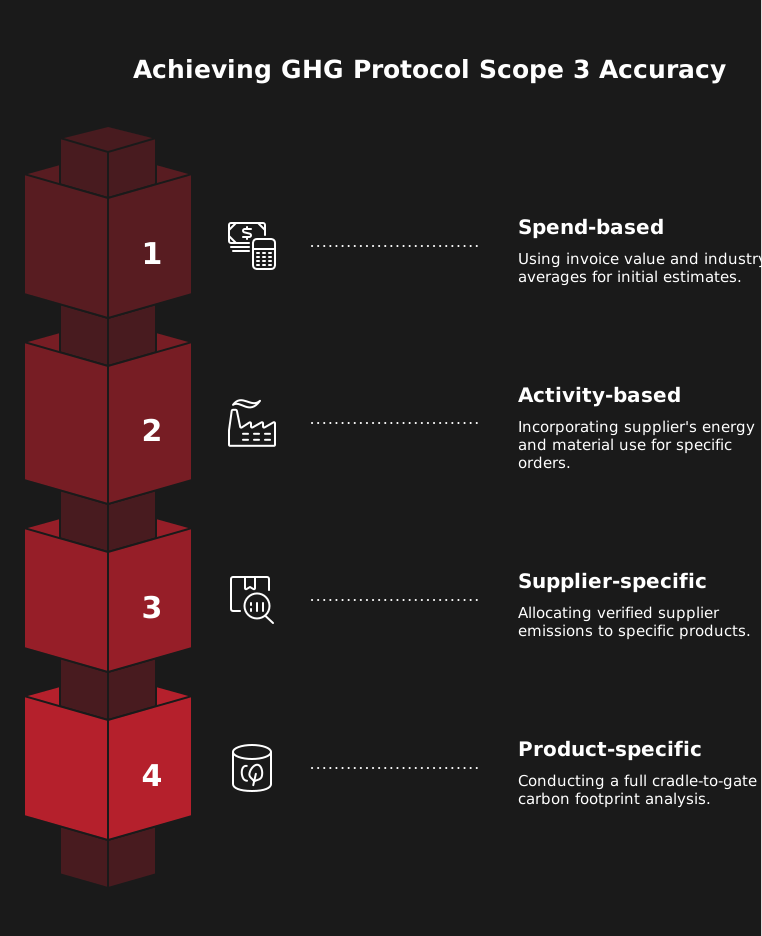
Its Scope 3 technical guidance ranks four calculation methods in increasing order of accuracy. Where a supplier sits on this table is not the customer's decision to make.
| Method | What it is derived from | What it actually reflects |
|---|---|---|
| Spend-based | Invoice value × an industry-average emission factor | The sector's average carbon intensity per dollar spent |
| Activity-based | The supplier's own energy, fuel and material use for the order | What this supplier actually consumed to produce it |
| Supplier-specific | The supplier's verified emissions allocated to the specific product | A defensible, auditable number tied to this transaction |
| Product-specific | A full product carbon footprint, cradle to gate | The most granular figure the Protocol recognises |
The data already exists on the plant floor
Moving up that table requires the energy draw, fuel consumption and throughput a plant's automation and metering layer is already recording (the same figures that would go into that supplier's own Scope 1 and 2 inventory) to be logged at a granularity that can be allocated to a specific product run, and summed at the site only afterwards.
That is an instrumentation and retention decision, made at the point the metering is designed. A gate meter that only totals monthly site consumption can support a spend-based estimate. It cannot support an activity-based one, because there is nothing in it to allocate to one customer's order.
What has to be designed in, not audited in afterwards
- Sub-metering at the process or line level, so consumption can be allocated to a product.
- Fuel logs captured at the point of use (generators, forklifts, site vehicles), with no reconstruction later from purchase invoices.
- Retention that outlives the reporting cycle it was collected for, because a verifier asks for the source record.
- A named owner for the meter data, because an unowned sensor drifts out of calibration and nobody notices until an auditor asks for evidence it did not.
What a verifier actually asks
As a GHG Lead Verifier, the question I ask first is where the figure came from: the meter, the log, the date, and who can produce it again if asked twice. A spend-based estimate cannot answer that question by construction; it was never built to.
Regulation is deciding whether a supplier does carbon accounting, upstream of them and on their customer's timeline. The choice left to the supplier is whether the number their customer reports about them is one they controlled, or one an industry average produced on their behalf.