Orion Five Engineering

10 Jalan Kilang #04-05, Singapore 159410
+65 6100 5505

Book a scoping call

Approach

Decide what the innovation is for, before you decide what to build

There is no single kind of innovation. Which one applies depends on where your company is, where it is heading, and what you want out of it. Our in-house Registered Management Consultants settle that with you before anything gets designed.



How much risk sits behind any of these depends on whether you are trying to expand the business or hold current revenue and profit. Most companies are pursuing more than one outcome, which means more than one strategy. Our in-house Registered Management Consultants work that out with you before anything gets designed.

A machined steel manifold block on a dark ground, one red light line entering a single face and leaving through several divergent outlets.
FIG. 01One objective, more than one strategy. So the map below traces two of them side by side instead of picking one and calling it the plan.

How an objective becomes work on the ground

FIG. 02

Two strategies, traced from the financial objective down to the skills that have to exist for it to hold. This is how we keep your build tied to the outcome you commissioned it for.

Revenue growth

New services and product offerings, and broader sources of revenue from the customers you already have.

Productivity strategy

Better operating efficiency, through lower manpower demand and more effective work on the ground.

Improve returns

Financial

Revenue growth

Broaden revenue mix

Productivity strategy

Improve operating efficiency

Customer

Revenue growth

Increase customer confidence

Productivity strategy

Increase customer satisfaction

Internal

Revenue growth

Understand customer segment

Develop new product

Cross-sell products

Productivity strategy

Reduce manpower

Minimise problems

Effective inspection

Learning and growth

Increase employee productivity

Develop strategic skills

Access to information

SkillsFuture for staff

Act 01

Who writes your strategy

A map is only as good as the judgement behind it. Here is who produces that judgement, and what they can be held to.

The consultant

UNIT 01

Who decides what your project is for

The engineers who will build your system do not write the strategy. A Registered Management Consultant does, a certification recognised by Enterprise Singapore and aligned to TR 43:2015 and SS 680:2021, with certifying bodies accredited by the Singapore Accreditation Council.

The certification is not permanent. Holders sit periodic reassessment, keep up continuing professional development, and answer to a code of conduct with disciplinary consequences. Any integrator can call someone a consultant. This is the version an outside body can take away.

  • Held in-house, not engaged for the proposal and gone after it
  • Aligned to TR 43:2015 and SS 680:2021
  • Certifying bodies accredited by the Singapore Accreditation Council
  • Subject to reassessment and a code of conduct
Six identical machined steel blanks standing in a row on a dark ground, one of them carrying a painted red witness stripe across its face.
FIG. 03One of the six is what the money is behind. Establishing which, and putting it in writing before an engineer has drawn anything, is the first of the four duties below.
  1. Before the design

    Settles which of the six outcomes is actually being pursued

    Most companies arrive naming one outcome and funding another. The consultant works out which objective your money is really behind and puts it in writing before an engineer draws anything. Every decision after that is measured against that sentence.

  2. During the design

    Holds the build to the objective it was commissioned for

    Every scope decision either serves the stated outcome or it does not. Someone whose only job is that question, separate from the engineers building the system, is how your build stops accumulating capability nobody asked for.

  3. At stage 03

    Writes the fixed-scope proposal you are asked to sign

    Scope, cost, and sequence in full, with the assumptions named. This is what the certification is really about: a proposal written to a published standard is one you can judge against that standard, ours included.

  4. Where funding is in scope

    Puts the project in the shape an assessor can read

    The Raymang Eggs robotics line was funded by an Enterprise Singapore Enterprise Development Grant, and the PestBusters programme was the country's first Lead Enterprise Development Scheme project. A grant assessor is reading for a defined business problem, a scoped project, and an outcome that can be measured. That is the same document the consulting stage produces.

The same person is still reachable when your system is commissioned a year later. A consultant hired to write a proposal and let go after it is not, and the proposal is where the commitments were made.

Act 02

The method, on two real projects

That's the theory. Here it is on two real projects — what we can show you, and what we're still asking you to trust.

The map, in use

UNIT 02

The same ladder, on two projects we delivered

FIG. 02 traces two strategies from a financial objective down to the skills underneath. Here we run it on two completed builds, in the same row order. One takes the productivity column, the other the revenue-growth column.

  • Improve operational efficiency · Raymang Eggs · 2022 — 2024
  • Develop a new product · PestBusters · 2016 and 2018
CASE 01

Raymang EggsRobotic carton removal line

Improve operational efficiency · Productivity strategy · 2022 — 2024

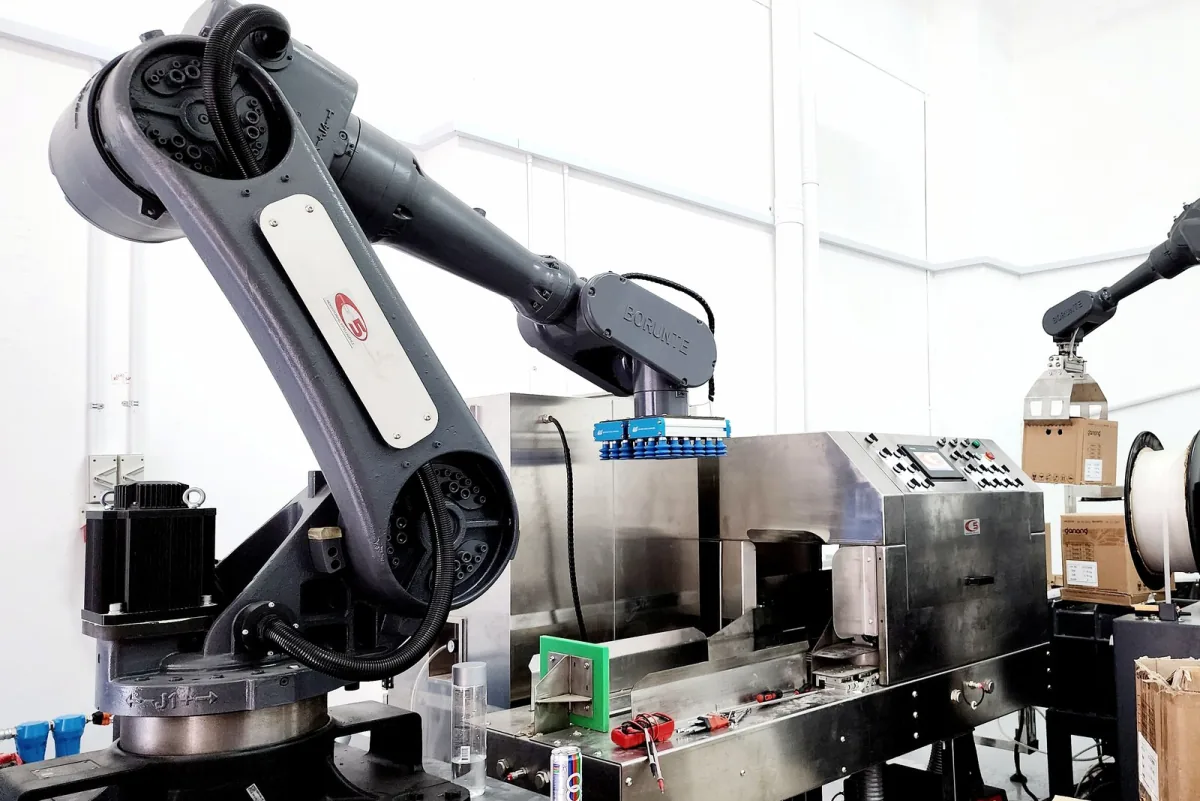
Two six-axis industrial robot arms installed over the automated carton cutting machine on the Raymang Eggs line.
Financial
Take cost out of a handling process that ran on people, with the capital part-funded by an Enterprise Singapore Enterprise Development Grant rather than carried whole by the business.
Customer
Distribution that holds its throughput on a short-shelf-life product, where a day lost to short staffing is not a day that can be made up later.
Internal
Reduce the manual labour the line depends on, and move the failure mode with it: a machine-set cut fails to a maintenance schedule, where a hand-fed one fails to whoever is on shift.
Learning and growth
The line needs people who can run and maintain three six-axis arms, which is a different job from the one it replaced. That skill is what the objective actually rests on.

What was built. Two six-axis industrial arms pick and place cartons into an automated cutting machine, and a third clears and disposes of the cut cartons. Unboxing that took the manual process 24 hours is done in one hour for the same volume of stock, and the process's dependence on manual labour cut.

The full entry
CASE 02

PestBustersIndustry transformation programme, phases one and two

Develop a new product · Revenue growth · 2016 and 2018

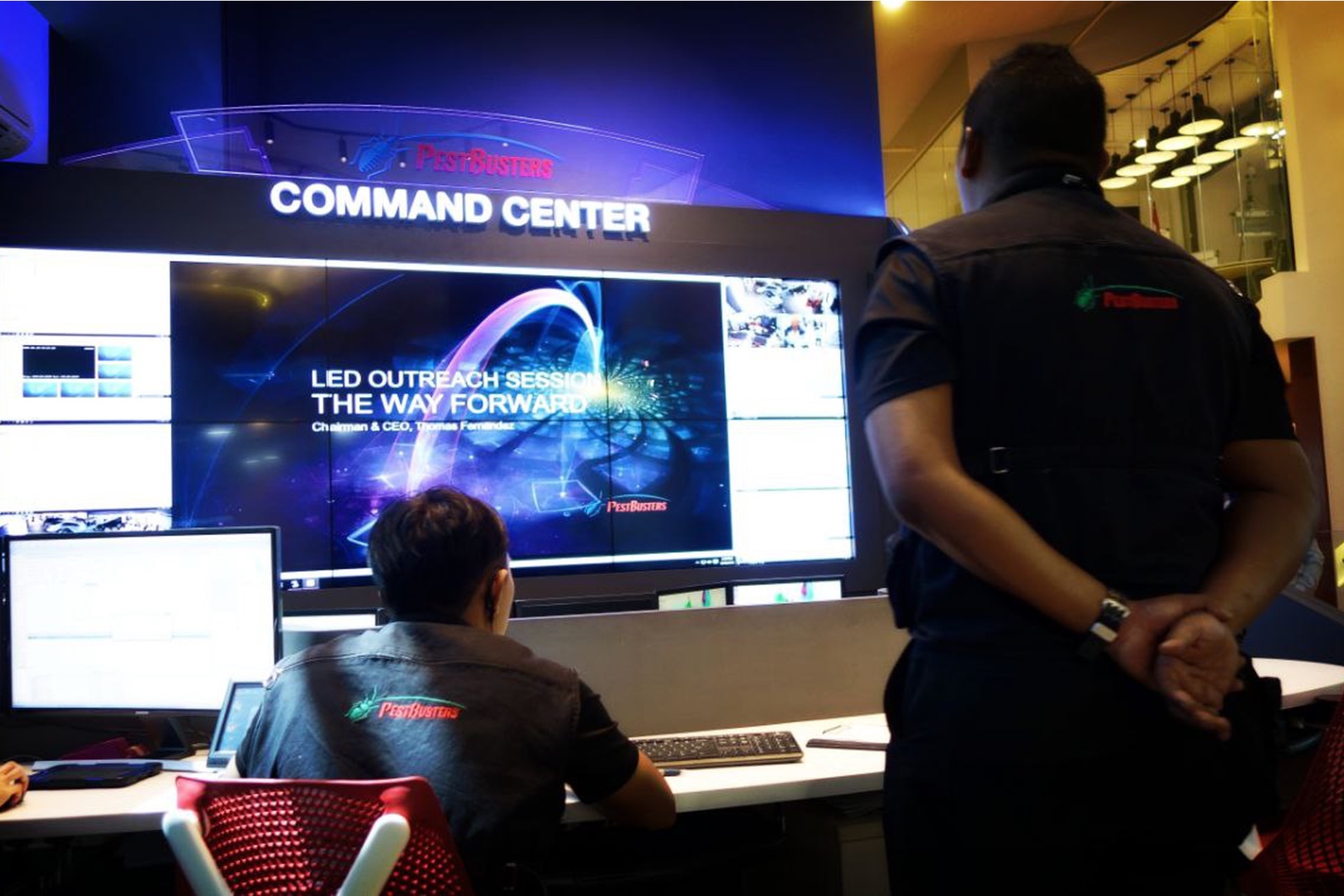
The PestBusters command centre, an operator at the console in front of a video wall carrying camera feeds and monitoring views.
Financial
Broaden the revenue mix. Monitoring that runs continuously is a different commercial shape from a scheduled visit, and it is sold to the customers already on the book.
Customer
Confidence that can be inspected. A device log and a live feed are evidence a client can look at; a technician's visit report is a claim they have to take on trust.
Internal
Understand the segment well enough to know which sites justify permanent instrumentation, then build the service around that rather than around the existing route sheet.
Learning and growth
Technicians who fly inspection drones, work a command centre, and read device telemetry. Phase two was only available because phase one had produced people who could run it.

What was built. Singapore's first Lead Enterprise Development Scheme project. Phase one covered fleet management, live-streaming body cameras, inspection drones, and a command centre. Phase two added IoT devices with web-based monitoring, intelligent rodent surveillance cameras, and intelligent rodent traps.

The full entry

The closing line of each case is the recorded engagement. The four rows above it are the objective structure the work was scoped against, not measured results.

Book a scoping call