
Sector notes
A five-year roadmap for autonomy: what to buy first, what to buy third, and what not yet
Every capability described across this shelf (retrofit-first integration, AMR safety standards, edge compute, digital twins) has to land in some order. Most autonomy programmes that fail bought the right technology in the wrong sequence.
Executive summary
5 yrs
the planning horizon this sequence is built across
5
phases, from instrumentation to agentic decision authority, in a specific order
Core conclusions
- The order of purchase decides more than the choice of technology.
- Instrumentation and a digital twin come first because nothing downstream is trustworthy without a model of the line that already agrees with reality.
- Agentic decision authority over physical actuation is the last capability to grant, after the data, the fleet, and the safety case all already hold.
An operator planning autonomy over the next five years is choosing an order. Buy the wrong thing first and the rest of the roadmap gets built on top of a gap nobody planned for; buy in the right order and the same capital produces a system that compounds instead of a set of pilots that never quite connect.
This is a synthesis. The shape below draws on the same evidence already on this shelf (ABI Research's AMR shipment forecast, NVIDIA's Jetson Thor edge-compute specification, ISO 23247's digital twin framework, and ISO 3691-4 and ANSI/RIA R15.08's safety requirements) sequenced into a five-year view.
The sequence, and why the order is not arbitrary
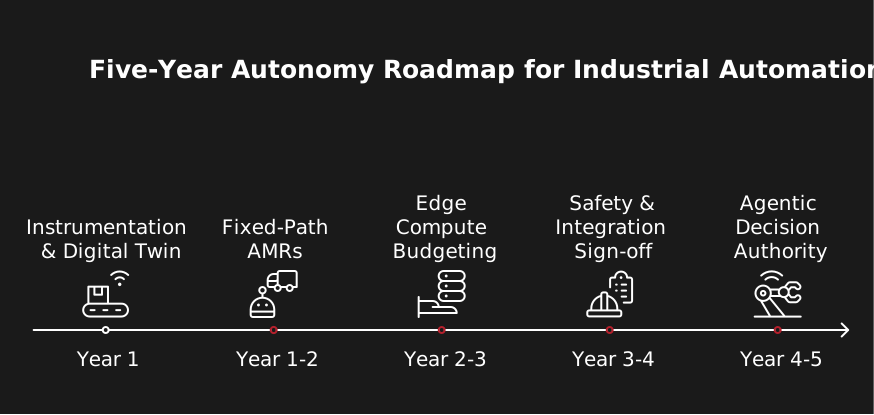
| Phase | What to buy | Why it comes here |
|---|---|---|
| Year 1 | Instrumentation and a digital twin scoped to ISO 23247, on the highest-value line only | Nothing downstream is trustworthy without a model of the line that already agrees with reality |
| Year 1 to 2 | Fixed or semi-fixed-path AMRs for a proven task: transport, picking, inspection | This is the category already shipping at volume and paying back inside a normal capital cycle, per ABI Research's 2023-to-2030 forecast |
| Year 2 to 3 | Edge compute sized to the actual autonomy budget: a Jetson Thor-class module or its equivalent, specified against a stated task | Autonomous decision-making that survives a dropped connection needs the compute physically present before it needs a bigger model |
| Year 3 to 4 | Safety and integration sign-off against ISO 3691-4 and ANSI/RIA R15.08, for anything moving near people | This is the point at which the fleet is large enough that an incident is a when. The standard exists to be designed to before that point |
| Year 4 to 5, and not before | Agentic decision authority over physical actuation: write-access to equipment | This is the last capability to grant, after the data, the fleet and the safety case all already hold |
The test that catches a roadmap out of order
Ask which phase above a proposal in front of you is actually funding. A pitch for autonomous decision authority over equipment, made to an operator that has no digital twin and no AMR fleet yet, is proposing to skip four years of the sequence above. The falsifiable version of that concern is simple: ask what the system will do the first time its recommendation and the plant's actual state disagree, and whether anyone has tested that disagreement yet. If the answer is no, the roadmap is out of order, whatever the pitch calls itself.