AI governance
Borrow SAE's five levels of driving automation for your machine's decision rights
SAE International's J3016 standard has, since 2014, given the automotive industry a shared six-level scale for how much a vehicle decides on its own. Industrial equipment has no equivalent, and that is a planning gap you can close today without waiting for one to be published.
Executive summary
2014
SAE International first published J3016's six levels of driving automation
6
levels on the scale, 0 (no automation) to 5 (full automation, no human role)
Core conclusions
- Industrial equipment has no shared vocabulary for how much decision-making it holds, so "autonomous" is left to do the work of a specification.
- A claimed level is a falsifiable statement in a way "autonomous" is not: it invites the question of what the defined exceptions are and how they were tested.
- Name the level being procured, name the evidence behind the claim, and revisit it every time the equipment's software changes.
Ask five vendors what 'autonomous' means for their equipment and the answers will not agree, because industrial automation has no shared vocabulary for how much decision-making a machine actually holds. The automotive industry solved the same problem in 2014: SAE International's J3016 standard defines six levels of driving automation, from Level 0 (no automation) through Level 2 (partial automation, human still monitoring) to Level 5 (full automation, no human role at all), and it has been revised several times since, most recently in 2021, without changing that basic ladder.
Nothing requires an equipment vendor to adopt J3016 itself. What it offers, on loan, is a discipline: state the level plainly, on a shared scale, so that 'autonomous' no longer has to do the work of a specification.
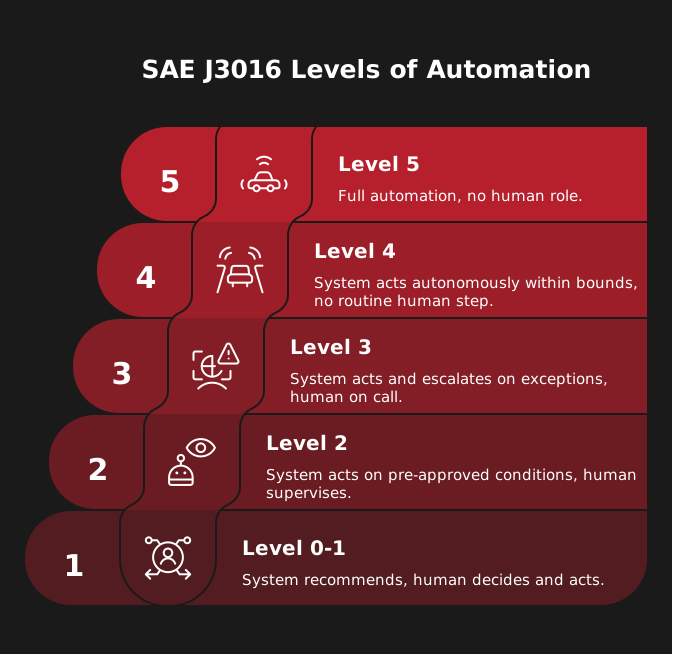
J3016's levels, mapped onto a piece of equipment
| SAE level | Driving equivalent | Industrial equipment equivalent |
|---|---|---|
| 0 to 1 | No automation, or driver assistance | The system recommends; a person decides and acts on everything |
| 2 | Partial automation, human still monitoring throughout | The system acts on a narrow, pre-approved set of conditions; a person supervises continuously |
| 3 | Conditional automation, human must be ready to intervene | The system acts and only escalates on defined exceptions; a person is on call |
| 4 | High automation within a defined domain | The system acts autonomously within a bounded task and environment, with no routine human step |
| 5 | Full automation, no human role | No industrial equivalent yet in general deployment; treat any vendor claiming this level as making an extraordinary claim |
Why the borrowed scale is useful even though it's informal
A level is a falsifiable claim in a way that 'autonomous' is not. If a vendor states their system operates at the equivalent of Level 3, you can ask what the defined exceptions are, what triggers escalation, and how that was tested. Those are the same questions the automotive industry has spent a decade asking about Level 3 driving systems, several of which turned out to still require far more human attention than the label suggested.
Use it in a spec: name the level you are procuring for a given piece of equipment, name the evidence that supports the claim, and revisit the level explicitly every time the equipment's software changes. A level claimed at commissioning is not guaranteed to hold after the fifth over-the-air update.