
Resources · Reference
Enclosure Rating Selector
Every retrofit sensor, edge gateway and camera ends at the same question: what does it go in. Pick the environment and this returns the minimum IP code, the nearest NEMA type, the material, and the specific mistake people make there, which is the part that actually costs money.
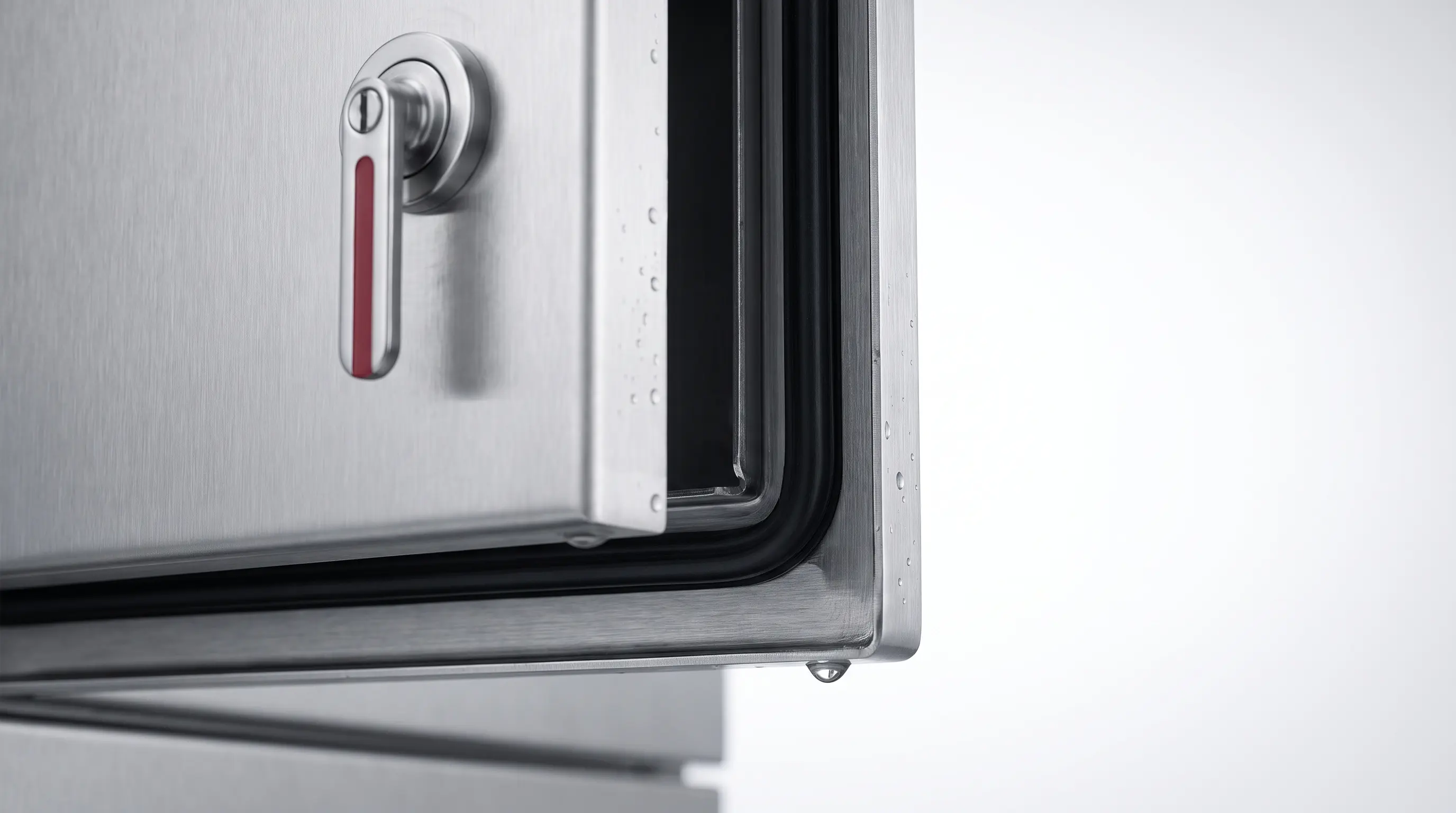
Where it goes
UNIT 01Outdoor, tropical
IP65IP code
Minimum IP65 minimum, IP66 preferred
Full sun, daily rain, high humidity, thermal cycling every day of the year.
Rain from any direction and dust-tight. In Singapore the rating is the easy half of the problem.
- Minimum IP rating
- IP65 minimum, IP66 preferred
- Nearest NEMA type
- Type 3R or Type 4
- Material
- Powder-coated aluminium, stainless, or UV-stabilised polycarbonate. Sunshade regardless.
- Environment
- Outdoor, tropical
What gets specified wrong here
Condensation is what actually kills these. The enclosure heats to 60°C in the afternoon, the air inside expands and escapes, and at 3am it cools and draws humid air back through the same imperfect seal. That moisture condenses on the coldest surface inside, usually a circuit board. Sealing harder accelerates it. A breather vent with a hydrophobic membrane, and an anti-condensation heater where electronics are involved, are what solve it.
Beyond the rating itself
- Hydrophobic breather vent: counter-intuitive and correct
- Anti-condensation heater with a hygrostat where electronics are inside
- Separate sunshade with an air gap, which is worth more than any upgrade in IP rating
- Mount clear of standing water and away from splash from below
Take it with you
↓The result as plain text. Paste it into an email, a board paper, or a request for quotation — no address needed, and it stays readable when it is forwarded to somebody who was not in the room.
IP code decoder
UNIT 02Two digits, and they are not a ladder
The first digit is solids, the second is water. They are independent tests, which is why IP69K does not imply IP67 and IP67 does not imply IP66. A seal that passes temporary immersion can fail a high-pressure jet, and a device rated for a jet may never have been tested under water. Where both matter, both have to be stated.
First digit — solids
- IP0x
- No protection.
- IP1x
- Objects over 50 mm, the back of a hand.
- IP2x
- Objects over 12.5 mm, a finger.
- IP3x
- Objects over 2.5 mm, a tool.
- IP4x
- Objects over 1 mm, a wire.
- IP5x
- Dust-protected. Dust enters but not enough to interfere.
- IP6x
- Dust-tight. No ingress at all.
Second digit — water
- IPx0
- No protection.
- IPx1
- Dripping water, vertical.
- IPx2
- Dripping water, tilted up to 15°.
- IPx3
- Spraying water up to 60° from vertical.
- IPx4
- Splashing water from any direction.
- IPx5
- Water jets, 6.3 mm nozzle.
- IPx6
- Powerful water jets, 12.5 mm nozzle.
- IPx7
- Temporary immersion, 1 m for 30 minutes.
- IPx8
- Continuous immersion, at a depth and duration the manufacturer must state.
- IPx9K
- High-pressure, high-temperature jets: 80 °C at 80–100 bar.
On NEMA equivalence
UNIT 03The NEMA types quoted above are the nearest equivalents, and that is all they are. The two systems do not map cleanly in either direction: NEMA types test for things IP does not (corrosion, ice, oil) while IP is more granular about the ingress itself. A NEMA type can generally be said to satisfy a given IP rating; the reverse cannot be assumed, and quoting an IP rating to satisfy a NEMA specification is not something a certifying body will accept.
Where a contract, a class society or a customer specification names NEMA, buy to NEMA. Where it names IP, buy to IP. Translating between them to use stock you happen to have is the kind of decision that is invisible for two years and then very visible at an audit.
One more thing worth stating plainly, because it is where enclosure projects actually fail: the rating belongs to the whole assembly. An IP66 enclosure with one oversized gland, one open knockout, or one cable entering through the top face without a drip loop is not an IP66 installation. On most sites, the enclosure is the part that was specified correctly.
Technical references
UNIT 04What the reasoning on this page is drawn from. Where a standard costs money to read it is marked, and where a free document covers the same ground better it is listed first.
- IEC 60529Paid standardIEC WebstoreThe IP code itself, the definitive source for what each digit is tested against, and the reason IP67 does not imply IP69K.
- NEMA standardsPaid standardNEMAIncluding NEMA 250, the enclosure type standard. Necessary reading before treating a NEMA type and an IP rating as interchangeable.
Links open in a new tab so anything you have entered above survives. Every one was checked at build time; if one has rotted since, tell us and it comes out rather than getting patched from memory.
Every one of these tools is a compressed version of a conversation. If yours turned up something you would rather talk through than read about, that is what the scoping call is for — bring your result with you.
Also on the shelf
- Reference
Protocol matrix
What each industrial protocol carries, what it will not do, and what it takes to bridge any one of them to any other.
- Reference
Glossary
The operational-technology and AI vocabulary a vendor will use in the first meeting, defined for the person paying.
- Tool
Readiness assessment
Score a proposed integration across the five dimensions that decide whether it survives contact with a plant floor, and find out which one is your binding constraint.